
In this Article
- The doorway favor table and the departure wave
- Escort card walls that become favor shelving
- Favors set on the charger before guests sit
- Rolling carts for hot pretzels and late pastries
- Twin consoles and a center departure lane
- Coat check and valet counters as handoff points
- Working the numbers on a 96-inch freight-elevator corridor
The Doorway Favor Table and the Twelve-Minute Departure Wave
One 6-foot banquet table set within 5 feet of the main egress doors can stall an entire reception. At industrial loft receptions where planners timed the departure waves, that single placement produced exit backups of 12 to 18 minutes during last-call shuttle boarding. Guests who needed to make the shuttle or a waiting rideshare simply walked past, and the boxes they skipped stayed on the linen at the end of the night.
The mechanics are easy to see once the floor is sketched. Couples saying long goodbyes stop in the threshold. Other guests stop beside them to squint at tiny gift tags in a dim hallway. Two kinds of stopping happen in the same few square feet, and the emergency egress path disappears under them.
Every favor zone that works, in any venue type, meets four spatial criteria:
- Clear aisle: an unobstructed 60-inch minimum around all exit doorways, which keeps two-way flow and meets commercial building egress codes for a corridor serving a seated reception crowd.
- Readable light: 150 to 200 lux of direct downward illumination on favor signage, so guests can read flavor or item labels from 6 to 8 feet away without pausing at the threshold.
- Thermal control: edible favors held below 72 degrees Fahrenheit and kept away from exterior vestibule doors, where HVAC air curtains swing 10 to 15 degrees each time the doors cycle open.
- Service access: rear or dual-side access so staff restock without stepping into the guest stream.
The six layouts below each satisfy those four criteria in a different way.
Escort Card Walls That Turn Into Favor Shelving After the Salad Course
Warehouse venues share a quiet inefficiency. Planners who tracked cocktail spaces found them sitting vacant for the final 3.5 hours of the event, while the exit doors absorbed the entire spatial load at the end of the night. That imbalance invites a two-stage fixture.
The fix places the favor on the seating display itself. Freestanding units built from 1.25-inch black malleable iron pipe, or weighted wire-grid walls, go at least 15 feet inside the cocktail reception perimeter so arriving guests have room to gather without blocking the entry. Escort cards hang in front; favors sit on the shelves behind them. Header signs in laser-cut steel or 0.25-inch matte acrylic, mounted 62 to 66 inches off the floor, stay legible from 12 feet away over the heads of a standing crowd.
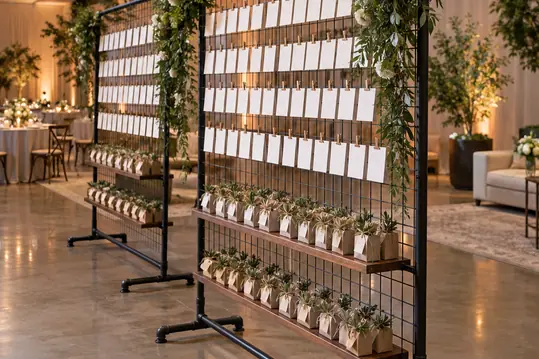
Guests claim their item during the staggered arrival window or carry it to their dinner table. Nobody queues for it at 11 p.m. The conversion happens during the 25-to-35-minute first-course salad service, when staff pull any remaining escort cards and spread the reserve favors across the middle three shelves as an open grab-and-go display.
Pigment Ink on Cotton Cards
DIY escort cards that double as favor tags get handled twice, once at arrival and again after dinner. Pigment ink sits on the surface of heavy cotton paper and resists smudging from warm hands far better than dye-based ink, which keeps names crisp through both stages of the display.
Setting the Favor on the Charger Before the Doors Open
Some rooms have no spare floor at all. Historic timber-and-brick venues often lack the 40 square feet of corridor clearance a perimeter table requires, and narrow ballroom foyers fare no better. Coordinators in those buildings moved the favor onto the dinner charger during the pre-ceremony setup.
Catering staff allocate 18 to 22 minutes per 150 place settings during the table dress to align each wrapped favor with the flatware and menu card. After that, the reception needs no active restocking and the doorway sees no congestion from favors at all.
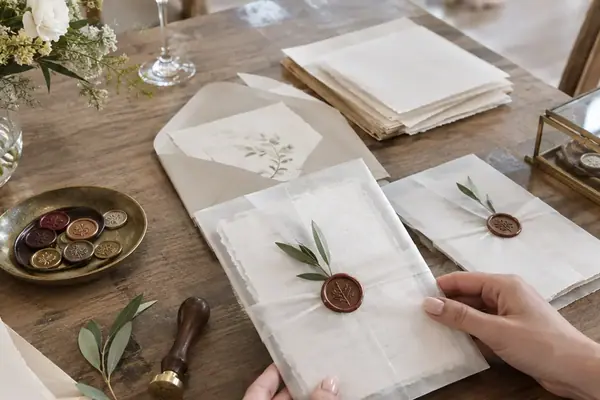
Signage moves onto the object. A DIY letterpress belly band printed on 110-pound cotton cover stock, or a 1-inch wax-sealed vellum tag attached to each box, replaces communal table signs entirely and ties the favor to the rest of the stationery suite.
One constraint governs box size. Plated multi-course dinners with preset salads and artisan bread baskets crowd 30-inch-wide table sections, leaving too little charger clearance for anything larger than 3 by 3 inches. If the menu is plated, size the favor down before ordering packaging.
Chocolate Under Halogen
Keep artisanal chocolate and buttercream favors off tables within 8 feet of west-facing factory windows or directly beneath 50-watt halogen pin-spots. Surface temperatures in those spots easily exceed 78 degrees Fahrenheit, well past the 72-degree ceiling edible favors need.
Steel Utility Carts for Hot Pretzels on the Dance Floor Edge
Warm favors fail on static tables. Catering teams that first planned warming cabinets near the coat check for late-night hot pretzels and mini pies watched static warming trays dry out pastry crusts within 35 minutes, and a five-hour reception gives a crust a long time to suffer.
The replacement is mobile. Heavy-duty 36-by-24-inch steel utility carts, or restored wire factory mail carts, ride on 5-inch locking polyurethane casters and roll out for the final 60 minutes of the reception. A clamp-on iron sign frame mounted 18 inches above the top tray lets guests spot the menu across a crowded dance floor.
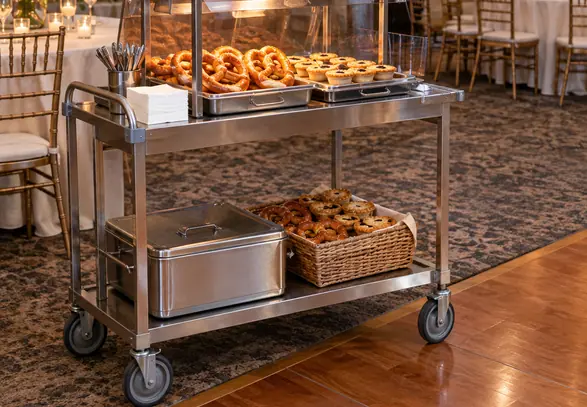
Placement does the traffic work. Carts parked along the active dance floor border catch guests before they turn toward the coat check, so the snack and the exit never share floor space. When a cart empties, bussing staff roll it back to the satellite prep kitchen and swap in fresh pre-loaded full-size 18-by-26-inch sheet pans in 90 to 120 seconds, without ever crossing the main exit foyer.
Twin Blackened-Steel Consoles and a Center Departure Lane
A single rectangular banquet table against one vestibule wall creates cross-traffic. Guests reaching across it block others heading for the stairs, and couples moving in opposite directions have to step around each other.
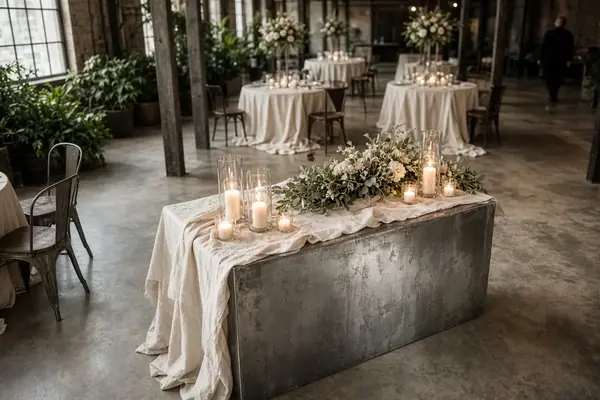
Splitting the display solves this. Two matching blackened-steel console tables, 16 to 18 inches deep, go on opposite corridor walls 10 to 12 feet upstream from the exterior doors. The space between them becomes a pass-through chute: guests walk down the middle and pull from the left or right console without breaking stride.
Restocking happens by the tray. Favors are pre-packed into shallow 2-inch-high wooden crates or galvanized wire baskets holding 20 to 25 units each, and a single server swaps an empty tray for a full one in under 15 seconds. Hand-stacking individual boxes in a live corridor is what this method eliminates.
Signage needs an angle. Matching high-contrast signs mounted at the leading upstream corner of both consoles, turned 30 degrees inward, give approaching guests the instruction 8 feet before they reach the grab zone.
Coat Check and Valet Counters as Built-In Handoff Points
A guest holding a coat, a pair of heels, and a borrowed centerpiece will not stop at a self-serve table. Coordinators who watched this happen repeatedly moved the favor inventory behind the staffed coat-check and valet ticket counters, where every guest already has to wait.
That wait runs 45 to 90 seconds while attendants retrieve coats or call vehicles. The attendant hands a pre-bagged favor across the counter with the claim ticket, which controls inventory flow and stops one guest from collecting six.
Outdoor valet stands change the packaging rules. Where indoor table favors fight heat, the threat at a covered valet stand is damp night air and condensation. Moisture-resistant 40-pound glassine bags, hinged tinplate boxes, or 18-point rigid kraft cartons hold up to it. Pigment-printed labels on those cartons stay sharp where water-soluble ink would bloom.
Backup stock stays in stackable plastic totes directly beneath the 42-inch counter, so attendants refill the tiered display rack on top between guest waves without leaving the station.
Use the Wait Already Built In
The strongest favor zones borrow a pause the guest is already taking. Coat check and valet create that pause for free; a separate table asks for a new one at the worst possible moment.
Working the Numbers on a 96-Inch Freight-Elevator Corridor
Take a third-floor masonry warehouse loft with 150 guests. Everyone leaves through one 8-foot-wide brick corridor that ends at a single freight elevator and an adjacent fire stair. Your goal is to hand out 150 favors without stalling elevator boarding. Three calculations get you there.
Step 1: Map the clearance
The corridor measures 96 inches. Subtract the mandatory 60-inch clear two-way egress lane and you have 36 inches of combined furniture depth to split across both walls. Nothing on either side can exceed that total.
Step 2: Choose and place the fixtures
Two 16-inch-deep blackened-steel consoles, one per wall, use 32 of those 36 inches. That leaves a 64-inch central walking lane, four inches wider than the minimum. Set both consoles opposite one another 15 feet back from the freight elevator threshold, so the grab zone sits upstream of the elevator queue and guests collect favors before they stop to wait.
Step 3: Load, light, and stage reserves
Load each console with three removable galvanized steel trays of 25 boxed favors apiece. Two consoles times three trays times 25 boxes gives you 150 units on display, one per guest. Clamp a 2700K directional LED task lamp to each console frame and aim it at a matte black acrylic sign, which keeps the label readable in a dim brick hallway and stays clear of halogen heat. In the service hall, park a rolling bussing cart holding two reserve trays of 25 units; when a tray empties, a server swaps it in about 15 seconds without stepping into the 64-inch lane. Those 50 reserve boxes cover plus-ones, a dropped box, or the guest who claims a second favor for a partner who left early.
Run the night forward and the corridor behaves: guests walk the center lane, pick up a box from whichever console sits on their side, and reach the elevator landing with the favor already in hand.



Write a Comment