

A memorable wedding table reveals itself in stages. Guests first register the silhouette, then the color, and finally the surfaces beneath their hands: a pleated runner, toothy stoneware, a wax seal with raised edges. Those physical details give industrial rooms warmth without concealing the brick, steel, and timber that made the venue appealing.
In this Article
- The rise of dimensional wedding tables
- Five textile details that add warmth
- Ceramics, sculptural wax, and metal
- Stationery guests can feel
- Texture control and table sightlines
- A one-item design-board audit
How Wedding Tables Gained Dimension
From the mid-century period through the late 1990s, reception luxury often rested on one dominant object: an elevated floral centerpiece measuring roughly 24 to 30 inches tall on a 60-inch round. The arrangement carried the visual argument, though guests frequently had to lean around it to hold a conversation.
Converted Midwest warehouses, tanneries, and grain-elevator lofts changed that equation. Their ceilings commonly rise 18 to 26 feet, where even a substantial flower dome can lose its impact. Designers began distributing interest across the table through varied heights, matte finishes, folded textiles, and objects that reward close inspection.
This shift suits industrial-chic weddings because tactile decor works with the room. A soft runner answers rough brick. Unglazed clay tempers polished flatware. Warm wax and woven fibers make steel columns feel intentional rather than severe. The underlying principles of tactile texture help explain why these contrasts produce visible depth even before a guest touches the table.
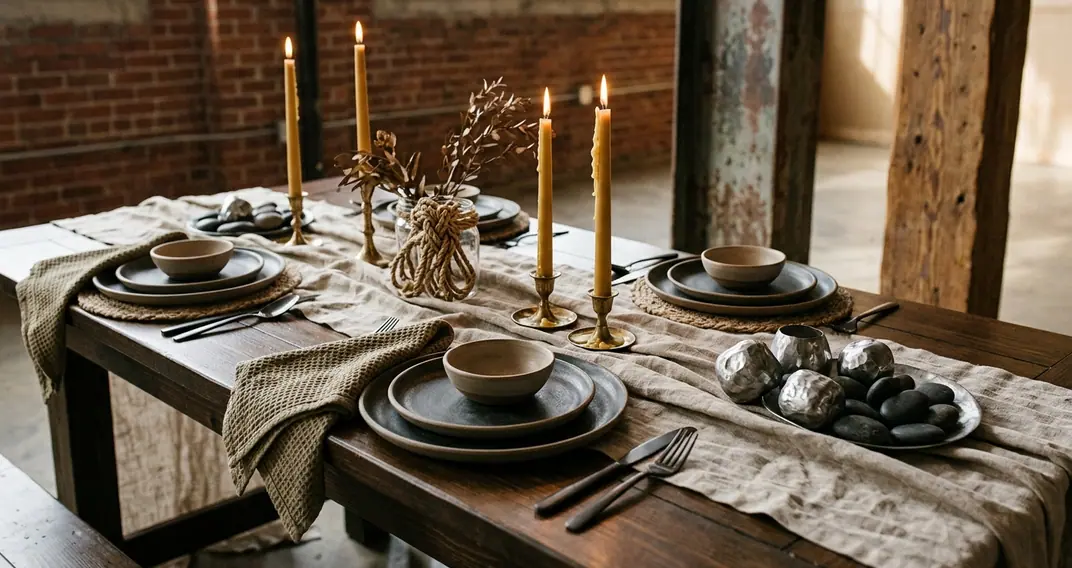
Venue timing also matters. These spaces commonly book 14 to 18 months ahead, so couples may commit to decor before seeing the room in the same season and light as their reception. Samples and a full table mockup become practical safeguards against finishes that looked dimensional on a screen and disappear in person.
Five Textile Details That Warm Brick and Steel
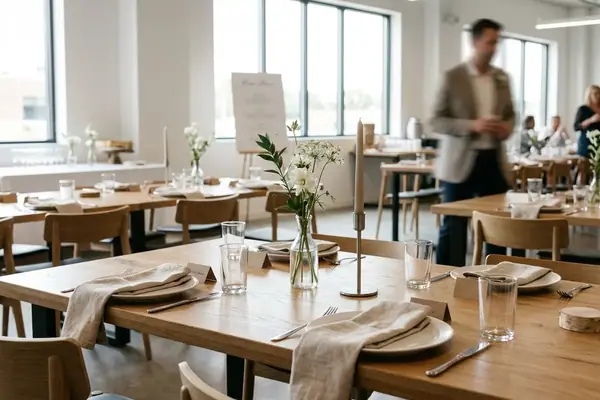
1. Pleated runners create controlled bands of light and shadow. On a 60-inch round, a finished width of 14 to 16 inches leaves workable room for chargers; wider runners begin pushing place settings toward the edge. A 108-inch pleated runner consumes about 7.5 to 9 feet of fabric before hemming because the folds require around 2.5 to 3 times the finished length.
Lighting determines the pleat style. Knife pleats form rhythmic shadows under low-hung warm bulbs, yet tall sash windows can flatten those folds into ordinary creases during an afternoon reception. Test one runner at the actual meal hour before approving the full order.
2. Embossed linens add a low-relief pattern without introducing another color. 3. Raw silk or dupioni napkins contribute more pronounced texture. Fabric in the 19 to 22 momme range holds a hand-folded shape through a seated dinner, while 20- to 22-inch squares have enough body to drape over a chair arm.
4. Rattan charger bases establish a woven boundary beneath smooth plates. 5. Macrame chair details move that warmth beyond the tabletop, which can help soften rows of metal or bentwood seating in a large warehouse.
Pleat Timing
Steam pleats 36 to 48 hours before installation and transport them flat in garment boxes. Pleats pressed more than four or five days early relax noticeably in humid Midwest air from June through August.
Clay, Candle Wax, and Patinated Metal
6. Unglazed stoneware offers a matte, slightly toothy counterpoint to polished silverware. Cone 6 stoneware also handles food service more reliably than lower-fired earthenware, which feels chalkier and can stain when exposed to red wine or beet-forward courses.
Handmade clay carries production constraints. Stoneware bodies shrink roughly 11 to 13 percent between wet throwing and final firing, so a maker may throw a plate at about 9.5 inches to achieve an 8.5-inch finished diameter. Separate batches rarely align perfectly. Small studios generally fire 30 to 60 pieces per kiln load and require 6 to 10 weeks from order to delivery.
That variation works beautifully across 60 to 80 settings. Beyond about 150 guests, uniform handmade place settings become difficult for a single studio to supply in one season. A production stoneware line can cover the guest tables while handmade plates and serving vessels distinguish the head table.
7. Sculptural candles supply architecture at a smaller scale. Ribbed pillars, twisted tapers, and geometric blocks hold their own without dense flowers. A 3-by-6-inch ribbed pillar burns for approximately 40 to 55 hours. A 10- to 12-inch twisted taper lasts about 5 to 7 hours, enough for one seated dinner.
8. Brushed brass or oxidized copper holders anchor those softer forms. Copper patina developed with vinegar and salt needs 48 to 72 hours to set, followed by a matte sealer before the holder touches linen. Unsealed oxidation can transfer directly onto pale fabric.
Flame Clearance
Set every candle at least 4 inches back from the charger’s outer edge so sleeves and reaching hands clear the flame.
Paper Details With a Physical Impression
Stationery brings texture into the guest’s immediate reach. The paper stock should lead the specification because weight controls how embossing, vellum, and wax behave.
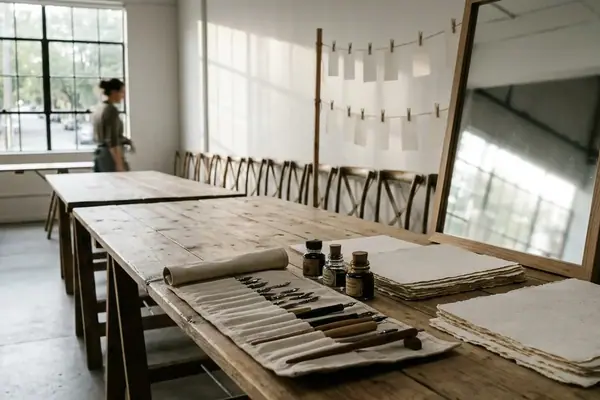
9. Blind embossing presses a design into soft, uncoated cotton rag without adding competing pigment ink or foil. Stock in the 300 to 600 gsm range holds the impression well; duplexed 600 gsm sheets produce the deepest result. Below about 250 gsm, the impression can punch visibly through the reverse. Thick strokes and open letterforms also retain their shape better than hairlines as the fibers relax.
10. Translucent vellum layered over cotton rag gives menus and place cards a deliberate reveal. Vellum at 100 to 120 gsm holds a crease and resists curling. Lighter 60 to 70 gsm sheets can cockle within hours when relative humidity rises past 60 percent or so, a familiar July and August condition in unconditioned warehouses.
11. Custom wax seals complete the tactile sequence. A 25- to 30-millimeter seal sits comfortably on a 4-by-9-inch menu. Applied directly to a vellum band, it feels integrated rather than appended.
Die Deadline
Custom embossing dies typically take 10 to 15 business days after artwork approval. Order them 10 to 12 weeks before the wedding to preserve time for a proof round. For 200 settings, a two-person team can expect somewhere around 3 to 4 hours of wax-seal assembly.
Keeping Eleven Details From Crowding the Table
An object count gives a misleading picture of clutter. A rattan charger, linen napkin, and stoneware plate can read as one cohesive gesture, while three unrelated bud vases may look scattered. Count tactile families instead: woven fiber, matte clay, and sculptural wax form a manageable trio.
Pair every pronounced surface with visual rest. Ribbed candles benefit from clean linen around their bases. Embossed menus sit more clearly against smooth plates. Leave 8 to 10 inches of uninterrupted linen or bare wood per place setting; below about 6 inches, the table tends to photograph as congested even when the individual pieces coordinate.
Protect the Conversation Line
Keep the zone from 12 to 26 inches above the tabletop clear, apart from tapers no thicker than 1 inch. That band aligns with the practical sightline between guests seated across a 60-inch round.
Tactile spending should also stay within the approximate 14-inch reach from each place setting. Guests rarely touch objects beyond that forearm boundary. Texture placed farther away functions as scenery and competes with the venue’s brick, beams, and steelwork.
Build one complete mockup 6 to 8 weeks before the date. Photograph it under the reception lighting instead of relying on overhead daylight, then remove any finish that duplicates an existing venue surface or obscures a useful patch of negative space.
Replace One Flat Rental Item Today
A full tactile overhaul can turn a design conversation into a budget stalemate. One carefully chosen swap creates a visible and physical improvement while keeping rentals, labor, and setup under control.
Start with the item guests handle most: the napkin. Replace standard polyester with washed or slubbed linen in the 165 to 200 gsm range. Typical rental pricing rises from roughly $0.75 to $1.25 per polyester napkin to $2.50 to $4.00 for specialty linen, adding about $350 to $650 across a 200-guest reception.
If textiles already carry enough character, test candle scale instead. Replace a standard 2.5-inch glass votive with a 3-inch ribbed pillar or staggered 6-inch and 9-inch column candles on the head table, then assess whether the treatment deserves wider use.
Order physical samples 12 to 16 weeks before the wedding; specialty linen and ceramic rental houses commonly ship a single-setting kit within 5 to 10 business days. Open the current design board now, circle one plain polyester napkin or standard glass votive, and request its tactile replacement sample.




Write a Comment