

In this Article
- Late-afternoon light inside a converted factory
- The 60/30/10 balance for three metal finishes
- Architectural copper across the largest surfaces
- Brushed gold at the table’s touch points
- Industrial steel at seated sightline
- The finished head table at dusk
Late-Afternoon Light Across the Factory Floor
Late October sunlight enters a converted Midwest manufacturing plant through west-facing grid windows, crosses the polished concrete, and reaches a fully set dinner table from the side. Copper rims turn russet. Candle cups glow. The dark lines of the window frames fall across the linen in long rectangles.
An hour earlier, the same table can look severe. Retrofitted high-bay fixtures in converted plants commonly sit 18 to 26 feet overhead and run between 4000K and 5000K. Candlelight sits near 1800K to 2200K, while Edison-style strings tend to fall between 2400K and 2700K. A highly reflective metal catches both lighting states at once: cold white from above and amber from table height.
That split reflection is why an attractive showroom finish can become distracting in a warehouse. Polished chargers form bright rings in photographs. Mirror-finish flatware sends concentrated glare toward the person seated across the table. Farther out, the dark corners swallow small decorative pieces, leaving the room visually busy at close range and sparse from the entrance.

The Useful Window-Light Interval
During the final week of October, usable raking light through west-facing grid windows in the upper Midwest generally arrives from somewhere around 4:45 to 5:30 p.m., before daylight saving time ends. After the clock change, comparable light falls closer to 3:45 to 4:30 p.m. Ceremony timing, room access, portraits, and candle lighting all need to acknowledge that shift.
The styling decision followed two site visits and three walks across the same plant floor at different hours. Midday glazing pushed flat white light down onto the tables, making every polished object behave like a small mirror. Late afternoon revealed the more useful condition: directional light with enough warmth to articulate texture.
Factory-Light Check
Set one complete place setting beneath the operating high-bays, then view it from the opposite chair. A metal finish should be approved from seated eye level, not from a standing position beside the table.
Balancing Wedding Metals with the 60/30/10 Rule
Three criteria govern this palette, in a deliberate order. Glare reduction comes first, because reflected light affects guest comfort and photography. Architectural harmony follows; exposed brick, riveted columns, and structural glazing already command the room. Autumn warmth ranks third because linen, candlelight, foliage, and floral material can correct a palette that leans slightly cool.
The 60/30/10 rule gives each metal a physical job. The dominant finish occupies roughly 60 percent of the visible metal and carries the broad surfaces. A secondary finish takes 30 percent through repeated, smaller elements. The final 10 percent works as punctuation, tying the tabletop back to the building.
For an industrial autumn wedding, the split resolves clearly: unlacquered copper carries the arch span, 13-inch chargers, and centerpiece vessels; brushed gold covers flatware, taper holders, and printed type; gunmetal appears in dense, compact objects such as table-number stands and chair frames.
Why the Ratio Needs a Full Place Setting
The combination was pressure-tested on an 8-foot table seating ten. Settings sat 26 to 30 inches center-to-center to accommodate 13-inch chargers. That tighter arrangement exposes conflicts quickly because metal edges repeat at short intervals and visually overlap with neighboring flatware, candle holders, and vessels.
Emily Carter, Editorial Director at Chicago Factory, identifies the broader movement as a shift away from the pink saturation associated with rose gold, which peaked on wedding tables in 2016 and held through about 2018. Midwest planner requests moved toward architectural and unlacquered copper through the 2024 and 2025 autumn seasons, favoring surfaces that gain character from handling and changing light.
The palette holds at three metals and breaks at four. Chrome, nickel, or mirror-polished silver introduces a new reflection profile. Once the high-bays come up, that fourth finish interrupts the hierarchy and makes the table read as a collection of rental packages rather than one composed setting.
Architecture Sets the Split
This ratio presumes that exposed brick, structural glazing, or riveted steel already contributes to the composition. In a white tent or carpeted ballroom, a 10 percent gunmetal share loses that architectural reference and may look disconnected.
1. Architectural Copper as the 60 Percent Foundation
Architectural copper earns the dominant share because its earthy orange-brown tone remains legible under both cool high-bays and warm candlelight. It also connects autumn foliage to exposed brick without asking the floral palette to carry all of the seasonal color.
The finish matters. A test with polished, lacquered copper aimed to spread candlelight along the table. Under 4000K overhead fixtures, the surface instead caught a hard white stripe across the arch and charger rims. Unlacquered copper softened that stripe and retained visible tonal depth when the room lights dimmed.
Put Copper on Continuous Surfaces
- Structural arches: Use copper across the broadest span so the dominant metal reads from the room entrance.
- Charger plates: Repeat the finish at every seat, establishing a steady visual rhythm beneath the smaller gold elements.
- Heavy centerpiece vessels: Choose a few substantial forms rather than scattering miniature metallic accessories between floral stems.
Copper arches are commonly assembled from 3/4-inch rigid tube sold in 10-foot lengths. Sections may be sweated or coupled into a span measuring 7 to 9 feet. At that scale, a two-post structure weighs roughly 30 to 45 pounds before floral material is added. Base plates provide appropriate stability on polished concrete, where bulky sandbags remain conspicuous and can create awkward footing near an aisle.
Unlacquered 13-inch copper chargers weigh about 1.4 to 1.8 pounds each. Their weight helps them sit securely beneath the place setting, but crews need to account for the combined handling load when moving racks between staging and the dining floor.
Choose the Patina Before Setup Day
Handling alone can darken unlacquered chargers noticeably within three to six weeks. A salt-and-vinegar wipe can force comparable depth within a day or three. Both states respond more gently to overhead light than factory-bright stock, though every charger should reach a similar tonal range before packing.
Copper Patina Window
Complete any forced patina several days before installation. That interval leaves time to compare pieces in rows, correct unusually bright chargers, and dry every surface before it contacts linen.
2. Brushed Gold for the 30 Percent Touch Layer
Brushed gold supplies refinement without turning the tabletop into a bank of reflectors. Its directional grain scatters light across the finish instead of concentrating a sharp return. That behavior matters most at eye level, where guests face repeated forks, knives, and candle holders for several hours.
In the exposure test, a mirror-polished gold fork beside a 13-inch charger threw overhead light toward the guest across the table whenever a fixture sat behind that person. The brushed version spread the reflection along its grain. It still looked warm in photographs, yet the bright point disappeared.
Reserve Gold for Repeated Details
- Flatware that guests handle throughout dinner
- Taper candle holders placed between floral vessels
- Fine stationery typography printed with warm gold Pigment ink
These elements form a coherent secondary layer because they recur without occupying large uninterrupted areas. Covering the arch or every centerpiece vessel in gold would pull attention away from the copper foundation. Confine gold to touch points and slender vertical lines.
Most brushed-gold rental flatware uses a PVD coating rather than plating. The coating tolerates repeat service, though pieces should be hand-dried within something like 15 to 20 minutes of washing. Water spots register as a dull cast in reception photographs, especially where side light runs across the utensil grain.
Match the Tapers to Dinner Service
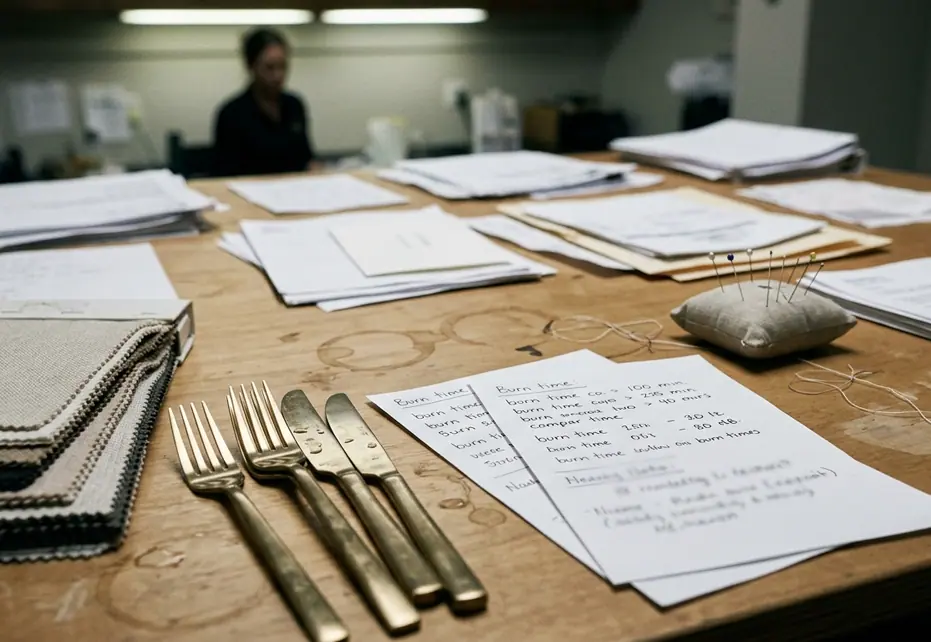
Ten-inch tapers generally burn for about seven to nine hours, while 12-inch tapers last roughly 10 to 12 hours. Either size can carry a reception from a 5:30 p.m. lighting through the last dance without a mid-service relight. The choice then comes down to sightlines: a taller taper needs enough spacing to avoid obscuring faces across a tightly set table.
Gold Service Pass
Inspect flatware under the venue lights after drying. Rotate visibly streaked pieces out before the place settings are built; correcting them later disturbs chargers, menus, and napkin folds.
3. Industrial Steel in the Final 10 Percent
Gunmetal and blackened steel reconnect the warm tabletop to the factory shell. Ceiling trusses may appear prominent while the room is empty, but they largely leave a seated guest’s view once tables, floral work, and other diners fill the foreground. Small steel elements bring that architectural line down to eye level.
The effective placements are compact: table-number stands measuring roughly 5 to 7 inches tall on 4-inch bases, dark steel chair frames, and blackened flatware rests. Together, they cover well under one-tenth of the visible tabletop. Their density matters more than their surface area.
Keep Steel Low and Deliberate
A blackened table-number stand creates a sharp vertical mark between copper vessels. Chair frames continue the line below the tabletop. In this role, steel behaves like an outline around the warmer materials, preventing copper and gold from drifting toward a conventional barn or country-club palette.
Waxed blackened steel and gunmetal rentals show fingerprints within a single service. Build a wipe-down into the half hour or so between the ceremony and reception entry. Handle stands by their bases after cleaning, then align them from the main guest approach so their silhouettes repeat cleanly down the room.
Steel Fingerprint Pass
Assign the final wipe to one crew member after place cards and table numbers are positioned. Repeated handling by several people quickly restores the marks that the cleaning pass removed.
A Final Look at the Head Table
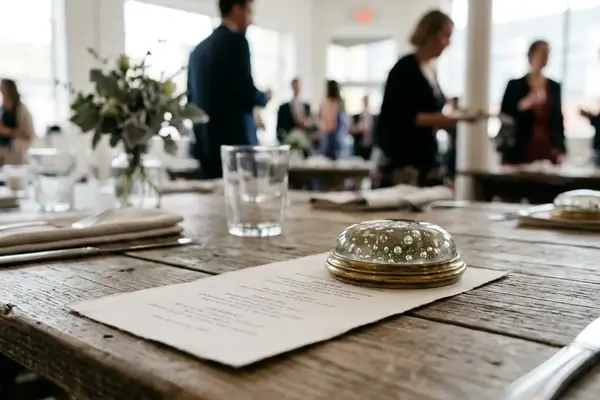
The head table deserves restraint because photographers view it from the front and at close range for long stretches. Pull copper back to the charger rims and one weathered vessel. Let brushed-gold forks and low candle holders repeat across the setting, while the dark beams remain visible behind the couple as a structural silhouette.
At a late-October reception, tapers lit around 5:15 to 5:30 p.m. overlap with the last window light for something like 20 to 35 minutes. During that interval, the room holds two directions of illumination. Side light traces the copper edge; candlelight warms the matte grain of the gold. Dimmed high-bays leave the gunmetal framework readable as architecture rather than another decorative object.
The couple reaches the table as daylight slips below the grid windows. One pulls out a dark steel-framed chair. A brushed-gold fork rests across the napkin, its surface quiet under the overhead fixtures, while a flame catches the worn rim of the copper charger. Behind them, the factory beams settle into shadow and the three metals finally read as one room.








Write a Comment